
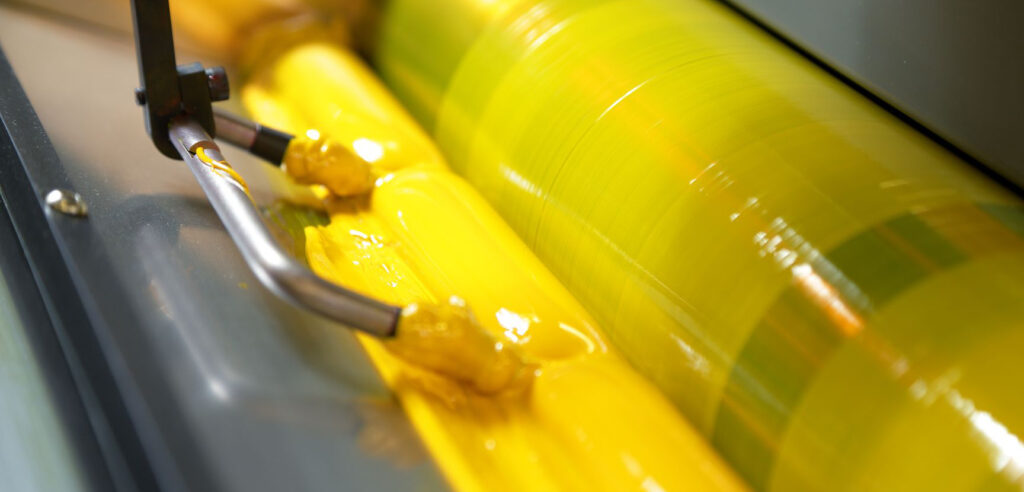
UV/LED inks are specially formulated to cure quickly when exposed to ultraviolet (UV) or LED light. These inks are commonly used in various printing processes, including offset, flexographic, and digital printing, due to their fast curing times, durability, and environmental benefits. Here’s a detailed breakdown of their composition:
Main Components
Monomers:
- Function: Serve as the primary building blocks that polymerize under UV/LED light to form the solid ink film.
- Types: Acrylic esters, methacrylates, and other reactive diluents.
Oligomers:
- Function: Provide the base resin for the ink, contributing to the film’s mechanical properties, such as flexibility, hardness, and adhesion.
- Types: Epoxy acrylates, polyester acrylates, urethane acrylates, and silicone acrylates.
Photoinitiators:
- Function: Initiate the polymerization process when exposed to UV/LED light, leading to rapid curing of the ink.
- Types: Benzoin ethers, benzil ketals, and other compounds that generate free radicals upon light exposure.
Pigments:
- Function: Provide color to the ink.
- Types: Organic and inorganic pigments, similar to those used in conventional inks.
Additives:
- Function: Enhance specific properties of the ink, such as flow, adhesion, and surface tension.
- Types: Stabilizers, wetting agents, dispersants, and defoamers.
Detailed Breakdown
Monomers:
- Constitute 30-70% of the ink.
- Provide viscosity control and determine the curing speed and final properties of the ink film.
Oligomers:
- Make up 20-50% of the ink.
- Influence the mechanical properties of the cured ink, such as hardness, flexibility, and adhesion.
Photoinitiators:
- Typically account for 5-10% of the ink.
- Essential for the curing process, ensuring that the ink hardens quickly under UV/LED light.
Pigments:
- Usually 5-20% of the ink.
- Provide the desired color and opacity.
Additives:
- Generally 1-5% of the ink.
- Improve performance characteristics like printability and stability.
Example Formulation
A typical UV/LED ink formulation might look like this:
- Monomers: 50%
- Oligomers: 30%
- Photoinitiators: 8%
- Pigments: 10%
- Additives: 2%
These components and their interactions enable UV/LED inks to offer rapid curing times, excellent print quality, and enhanced durability, making them ideal for a wide range of printing applications.
Facebook
Twitter
LinkedIn